


Glucoiberin Potassium Salt
CAS: 15592-34-4
CAT: 5060
Abstract
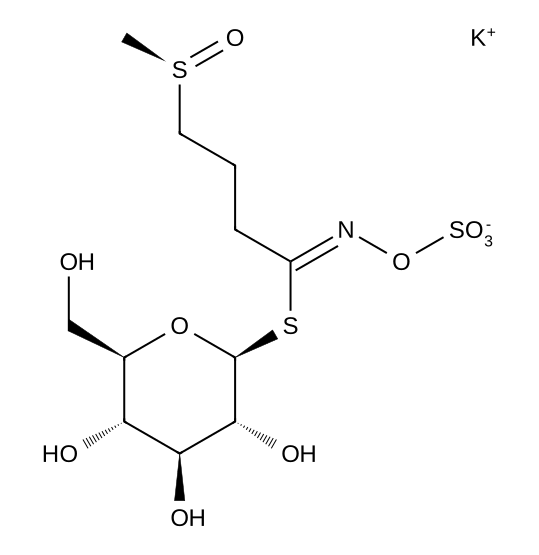
Glucoiberin (CAS 15592-34-4, as a K-salt) is in a group of sulfur-containing glycosides called glucosinolates. Glucosinolates are mainly present in cruciferous or brassica vegetables, such as broccoli, cabbage, cauliflower, rapeseed, and mustard. The sulfur group results in the pungent smell. Research indicates the beneficial effects of glucosinolates. These effects include regulatory functions in inflammation, stress response, phase I metabolism, antioxidant activities, and antimicrobial properties.
Glucoiberin may be isolated from cabbage, broccoli, and cauliflower. Myrosinase converts glucoiberin to iberin (3-methylsulfinylpropyl isothiocyanate), an isothiocyanate closely related to sulforaphane.
Glucosinolates are sold as their potassium salt form.
Follow this link for our entire collection of glucosinolate reference standards.
References
Compound Details
| CAS | 15592-34-4 |
|---|---|
| Molecular Weight | 461.6 g/mol |
| Chemical Formula | C₁₁H₂₀KNO₁₀S₃ |
| IUPAC | potassium [(Z)-[4-[(R)-methylsulfinyl]-1-[(2S,3R,4S,5S,6R)-3,4,5-trihydroxy-6-(hydroxymethyl)oxan-2-yl]sulfanylbutylidene]amino] sulfate |
| Synonyms | beta-D-Glucopyranose, 1-thio-, 1-(4-(methylsulfinyl)-N-(sulfooxy)butanimidate) |
| SMILES | C[S@@](=O)CCC/C(=N/OS(=O)(=O)[O-])S[C@@H]1O[C@H](CO)[C@@H](O)[C@H](O)[C@H]1O.[K+] |
| Purity | 95%+ |
| Storage Temperature | Below −18°C |
| Storage Conditions | Dry, freezer |
Product Documents
From $32.75 / mg
| Range (milligram) | Price ($/milligram) |
|---|---|
| 10 - 24 milligram | $36.50 / milligram |
| 25 - 99 milligram | $32.75 / milligram |
| 100 - 1000 milligram | Price on Request |
Technical Support
Product information is from published literature. Due to the nature of scientific experimentation, results or specific product application may vary (e.g., selectivity, detector response). If you have questions about the product, its application, and associated analytics, please contact our technical support team.
Product Use Disclaimer
Products are sold as laboratory reference materials, to be used for diagnostic and in vivo testing. The samples are not certified for veterinary or human use.
Related Products


