


Agrochemical & Biopesticide Analysis
Agrochemical analysis for naturally derived and synthetic actives, from routine assays to 5-batch analysis, in technical material, concentrates and finished formulations. We make the reference standards for avermectins, emamectin, spinosyns, neem limonoids and pyrethrins in our own lab, and the same chemists develop the methods that measure your actives, impurities and degradants.
Agrochemical analysis services
Active-ingredient assays
Each active component quantified in any product type: technical material, concentrates and finished formulations, against weighed, well-characterized standards. How quantitative HPLC works.
Impurity & related-substance profiling
Known related substances quantified against our standards, lot to lot. Unknown peaks are flagged and, when needed, isolated and identified. Impurity isolation.
Storage stability & degradants
Storage stability studies that track actives and their degradation products over time, plus standards and support for metabolite and soil-fate work.
5-batch analysis for registration
Registration support
Active content and related impurities across five production batches of your technical active, measured with a method built and validated for that active.
- 01
Batch samples
Send material from five production batches of your technical active. 5 g per batch is preferred; we can work with less.
- 02
Method development
We develop an in-house HPLC-UV/DAD method for your active and its related impurities, with MS to confirm identity.
- 03
Method validation
The method is validated before any batch is run, and can be transferred to your QC lab. Method validation.
- 04
5-batch analysis & report
Active content and related impurities measured in all five batches, reported batch by batch with the full data package for your dossier.
Conducted following GLP principles and ISO/IEC 17025 practices. Tell us at the quote stage what your registration authority requires.

Natural actives are mixtures, not single compounds
Abamectin is avermectins B1a and B1b. Spinosad is spinosyns A and D. Natural pyrethrum is six esters, and neem products carry azadirachtin alongside a family of closely related limonoids. Published methods for these actives often don’t resolve every component, so we develop and validate our own, calibrating each component against its own standard.
Our focus is the active substance: content, impurities and degradants. We do not run multi-residue pesticide screening of crops or foods.
What we test by product type
| Product type | What we test |
|---|---|
| Technical grade active (TGAI) | Active content, related impurities, unknown peaks identified, 5-batch analysis |
| Liquid formulations: EC, SC and oil-based products | Active content per component, degradants, storage stability |
| Solid formulations: WP and granules (GR, WG) | Active content, lot-to-lot consistency, storage stability |
| Botanical extracts and concentrates (neem, pyrethrum) | Every active component against its own standard, lot-to-lot consistency |
| Aged or off-spec material | Degradants and unknown peaks identified, isolated when needed |
Another product type? We test actives in any product type; tell us the matrix and the components you need measured.
Analysis by active class
Avermectins & abamectin
- What we measure
- Avermectin B1a and B1b content in abamectin, plus related substances: Z-isomers, oxo and hydroxy derivatives and minor avermectins.
- Method
- HPLC-UV/DAD; MS for identity
Emamectin
- What we measure
- Emamectin B1a and B1b content, plus related substances such as amino avermectin B1a and the 8,9-Z isomer.
- Method
- HPLC-UV/DAD; MS for identity
Spinosad & spinetoram
- What we measure
- Spinosyns A and D in spinosad, spinetoram J and L, and related spinosyns.
- Method
- HPLC-UV/DAD; MS for identity
Neem: azadirachtin & limonoids
- What we measure
- Azadirachtin A plus the related azadirachtins, nimbin, salannin and other neem limonoids, each resolved and quantified.
- Method
- HPLC-UV/DAD, built to resolve related limonoids; MS for identity
Pyrethrins
- What we measure
- All six pyrethrin esters (pyrethrins, cinerins and jasmolins I and II), plus chrysanthemic acid and pyrethrolone.
- Method
- HPLC-UV/DAD; MS for identity
Synthetic actives
- What we measure
- Active content and impurities in synthetic actives such as cyantraniliprole, difenoconazole, fludioxonil and thiamethoxam.
- Method
- HPLC-UV/DAD; MS for identity
ELSD is added for the occasional analyte with a weak UV response.
The standards behind the work
Each component we quantify is calibrated against its own reference standard, drawn from one of the broadest in-stock collections of biopesticide reference standards. They are the same standards you can order for your own lab.
Avermectins
- Avermectin B1a
- Avermectin B1b
- Avermectin B2a
- 8,9-Z-Avermectin B1a
- 8a-Oxo-Avermectin B1a
- 4″-Oxo-Avermectin B1a
Emamectin
All emamectin standards →Spinosyns & spinetoram
All spinosyn standards →Neem limonoids
All neem standards →Add any standard to your Inquiry List to run the analysis in-house, or read our neem limonoid and pyrethrin highlights. Target not listed? We can isolate and characterize it.
Who we help
Biopesticide manufacturers
Technical-grade active producers
Formulators & distributors
Registration & R&D teams
How it works
Share what you have
Tell us the active, the material (technical grade, concentrate or formulation), the components you need measured and what the data is for.
NDA if needed
We put an NDA in place to protect confidential processes, formulations and IP.
Formal quote
You receive a quote with the scope, method approach and timeline.
PO & shipment
Once we receive your PO, we coordinate shipment of your samples to our lab.
LIMS intake
Samples are logged in our LIMS, which you can follow on your dashboard, and assigned to an analytical chemist, your point of contact.
Analysis & report
We run the analysis and deliver your report with the full supporting data.
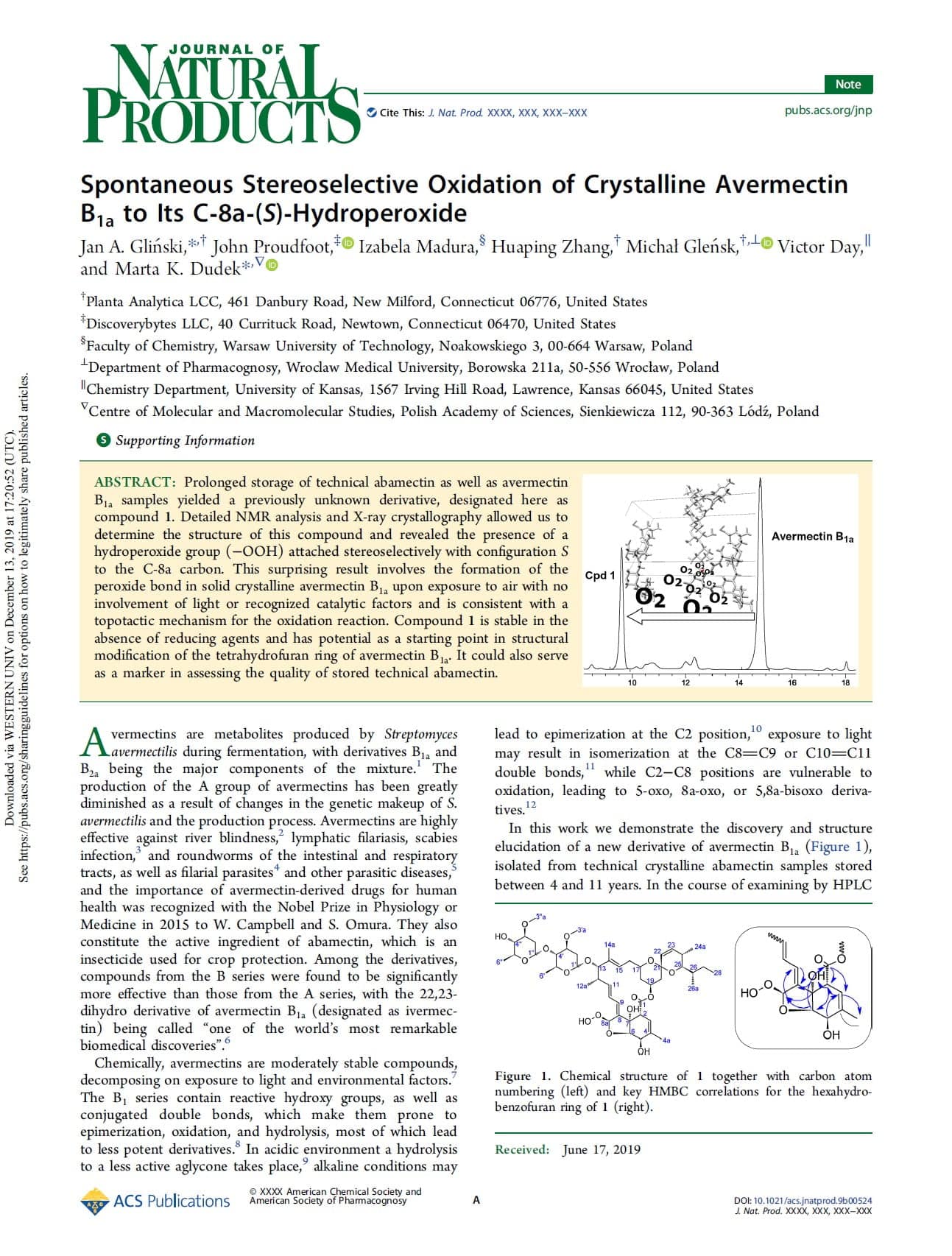
Published research: an unknown avermectin derivative
Spontaneous stereoselective oxidation of crystalline avermectin B1A to its C-8a hydroperoxide
Prolonged storage of technical abamectin as well as avermectin B1a samples yielded a previously unknown derivative. Detailed NMR analysis and X-ray crystallography allowed us to determine its structure and revealed a hydroperoxide group (-OOH) attached stereoselectively, with configuration S, to the C-8a carbon. The peroxide bond forms in solid crystalline avermectin B1a on exposure to air, with no involvement of light or recognized catalytic factors. The compound could serve as a marker in assessing the quality of stored technical abamectin.
Unknown peaks in aged or off-spec material are worth identifying. When one matters, our impurity isolation team isolates it for structure work.
Typical timelines
Routine analysis: typically 5 business days from sample receipt.
Larger studies: typically about 2 weeks.
Complex screening analysis: typically 3 to 4 weeks.
5-batch, storage stability, method development and validation: timeline set per project in your quote.
Quality
Batch Reports & Full Data Packages
- Analytical report — results per component with the method summary, chromatograms, calibration and calculations
- Batch reports — lot-by-lot and 5-batch results in one consistent format, as data packages to support your registration work
- Certificates of analysis (COAs) — prepared for your products as needed
- Order tracking — follow your samples on our LIMS dashboard from receipt to report
- Quote-based pricing — every project is quoted individually, with an NDA available
- Sample size — 5 g preferred minimum, flexible when material is limited
- Partner-lab testing — NMR, heavy metals and microbiology coordinated through partner laboratories
Frequently asked questions
No. We analyze the agrochemical actives themselves: active content, related impurities and degradants in technical materials and products. Multi-residue screening of crops, foods or supplements is a different service, best done by a residue laboratory. Many of those labs use reference standards like the ones in our agrochemical catalog.
Our core classes are avermectins and abamectin, emamectin, spinosad and spinetoram, neem azadirachtin and limonoids, and pyrethrins, and we analyze synthetic actives as well. We test any product type: technical material, concentrates and finished formulations such as EC, SC, WP and oil-based products.
Yes. We track active content and degradation products over time under the storage conditions and time points agreed with you at the quote stage, using the same validated methods. Degradants can be identified and, where needed, isolated as standards.
We use in-house methods developed and validated for each active. Published methods are a useful starting point, but for natural actives they often don’t separate every closely related component and impurity. Our methods are calibrated with standards we make for each component, and we can transfer them to your QC lab. See Method Validation.
MS in-house gives the molecular mass of an unknown peak and often its likely structure family. When a full structure is needed, we isolate the compound and characterize it, with NMR performed by partner laboratories. Our published avermectin B1a hydroperoxide study is an example. See Impurity Isolation.
Routine analysis typically takes 5 business days from sample receipt, larger studies about 2 weeks and complex screening 3 to 4 weeks; 5-batch, stability and method projects are scheduled in your quote. We prefer at least 5 g of sample but can work with less when material is limited. Pricing is quote-based, and an NDA is available.
Yes. Add the standards to your Inquiry List from the catalog. We can also develop and validate a method and transfer it to your QC lab.
Start your agrochemical analysis project
Tell us about your active, your material and what the data needs to support, and a Planta Analytica chemist will follow up with a scope, timeline and quote.