



Natural products used in nutraceuticals and agrochemicals show significant compositional variability arising from growing conditions, harvest practices, and processing. Therefore, natural product and nutraceutical quality control teams must implement layered controls to confirm identity, quantify active markers, ensure purity, and meet regulatory expectations under either FDA 21 CFR Part 111 for dietary supplements or EPA/FIFRA requirements for agrochemicals.
At Planta Analytica, we supply high-purity reference standards and provide integrated analytical services that support laboratories from raw material qualification through fully validated methods and outsourced testing.

Identity Testing and Raw Material Qualification
Effective nutraceutical quality control begins with robust identity testing of incoming botanical raw materials. Regulations require manufacturers to verify the correct genus, species, and plant part for every lot before release into production. A multi-tiered approach typically combines macroscopic and organoleptic evaluation with chromatographic fingerprinting (TLC or HPTLC) and, where needed, orthogonal techniques, such as HPLC.
For neem raw material destined for agrochemical use, identity confirmation precedes any limonoid quantitation. Proper species and seed-part verification prevents substitution or adulteration that could compromise five-batch analysis data required for EPA registration. Similarly, for cinnamon bark used in nutraceutical extracts, identity testing linked to procyanidin profiling helps detect common adulterants and ensures the material matches the intended chemotype.
High-purity reference standards support accurate peak identification in fingerprint methods and provide traceable calibration for subsequent potency testing. Establishing clear specifications for identity, purity, strength, and contaminants at the qualification stage reduces downstream rejection rates and strengthens audit readiness. Explore our full reference standards catalog to support your identity and potency workflows.
Reference Standards: Enabling Accurate Quantitation and Product Trust
Once identity is confirmed, high-purity reference standards become essential for reliable quantitation. In agrochemical applications, neem-derived limonoids provide a clear illustration. A well-characterized azadirachtin standard allows manufacturers to quantify the primary active content in technical-grade material or finished formulations.
This measurement gives end-users confidence that the product delivers the expected bioactive levels, while manufacturers gain effective tools for quality control and monitoring of incoming feeds or production batches. When a more comprehensive profile is needed, the availability of a large set of neem-specific limonoid standards gives laboratories the flexibility to select appropriate markers for the specific product type or regulatory dossier.
Method Selection: Rapid Screening versus Specific Quantitation
For nutraceutical extracts, such as cinnamon, rapid colorimetric assays serve as efficient tools for nutraceutical quality control and high-throughput screening. The Folin-Ciocalteu method estimates total reducing capacity, while DMAC offers a convenient assessment of total proanthocyanidin (PAC) content. These techniques provide fast turnaround suitable for incoming material checks or in-process monitoring.
However, when quantitation based on chemically defined compounds is required, HPLC-UV methods deliver superior specificity. Individual procyanidin standards enable precise measurement of specific dimers, trimers, or oligomers. In contrast, a general cinnamon PAC standard is difficult to characterize and maintain at consistent purity, which introduces uncertainty in calibration. HPLC-UV resolves individual peaks, removes matrix interference, and generates data suitable for stability studies and regulatory submissions.
| Aspect | Colorimetric Methods (Folin-C or DMAC) | HPLC-UV with Individual Procyanidin Standards |
|---|---|---|
| Speed & Throughput | Excellent for rapid screening | Moderate (longer run time, but automated) |
| Specificity | Low (measures total reducing capacity or total PAC) | High (resolves individual oligomers) |
| Quantitation Basis | Total response (prone to matrix interference) | Chemically defined compounds |
| Typical Precision (RSD) | 3–8 % | < 2 % (repeatability) |
| Accuracy/Recovery | Variable due to interferences | 98–102 % achievable with authenticated standards |
| Best Use Case | Incoming material screening, in-process checks | Release testing, stability studies, regulatory submissions |
| Validation Considerations | Simpler, but limited for specificity | Release testing, stability studies, regulatory submissions |
Method Validation Parameters
Any analytical procedure used for release or stability testing must be appropriately validated according to ICH Q2(R2) principles. For quantitative HPLC-UV methods applied to botanicals, such as cinnamon procyanidins, laboratories typically demonstrate:
- Specificity: Absence of interference from matrix or degradation products (often confirmed via forced-degradation studies).
- Accuracy: Recovery targeted at 98–102 % through spiking with authenticated reference standards.
- Precision: Repeatability (RSD < 2 % at target level) and intermediate precision across days, analysts, or equipment.
- Linearity: Correlation coefficient ≥ 0.999 over the reportable range (typically 5 concentration levels).
- Range: From quantitation limit to 120–130 % of specification.
- Quantitation Limit (QL) and Detection Limit (DL): Determined by signal-to-noise ratio.
- Robustness: Small deliberate variations in pH, temperature, or flow rate.
System suitability criteria (resolution, tailing, theoretical plates) ensure ongoing performance. Our services include support for partial or full validation packages and method transfer.
Detector Selection, Custom Isolation, and Practical Implementation
For compounds with suitable chromophores, HPLC-UV provides predictable, linear, and reproducible response factors that simplify method transfer. Certain analytes, such as actein and related triterpene glycosides from black cohosh, exhibit weak UV absorption. In these cases, evaporative light scattering detection (ELSD) produces a stronger, more predictable signal, enabling reliable quantitation despite the lack of a strong chromophore. Mass spectrometry remains valuable for structural confirmation or trace-level work but can introduce ion-suppression effects in complex matrices.
Custom Isolation and Characterization of Novel Standards
When suitable commercial reference materials are unavailable for new actives, impurities, or proprietary compounds, custom isolation offers a complete pathway. We isolate target molecules from source biomass, certify purity using orthogonal techniques, and develop supporting analytical methods.
Deliverables range from simple, rapid approaches (quick HPLC or UV spectrophotometric methods for internal QA) to fully validated protocols aligned with regulatory standards. This capability ensures that even novel or low-abundance markers can be quantified with confidence, shortening development timelines and supporting registration dossiers.
Practical Implementation: Partnering with a Specialized CRO
Building and maintaining an internal QC laboratory capable of identity testing, multi-marker quantitation, impurity profiling, forced-degradation studies, gravimetric standardization, and full method validation requires substantial investment in instrumentation, reference materials, trained personnel, and ongoing maintenance.
Partnering with a contract research organization such as Planta Analytica reduces operational costs while delivering consistent, high-quality results for your nutraceutical quality control needs. Because we routinely run these analyses and maintain an extensive in-house library of standards, clients benefit from faster turnaround times, minimized capital expenditure, and reduced need to internalize specialized capabilities.
Our support includes outsourced identity and purity testing, stability and forced-degradation programs, method development and transfer, contaminant testing, and comprehensive documentation for audit readiness. This model allows QA/QC teams to focus internal resources on core manufacturing and process oversight while ensuring defensible data for regulatory submissions and product release.
Conclusion: Building Defensible QC Programs
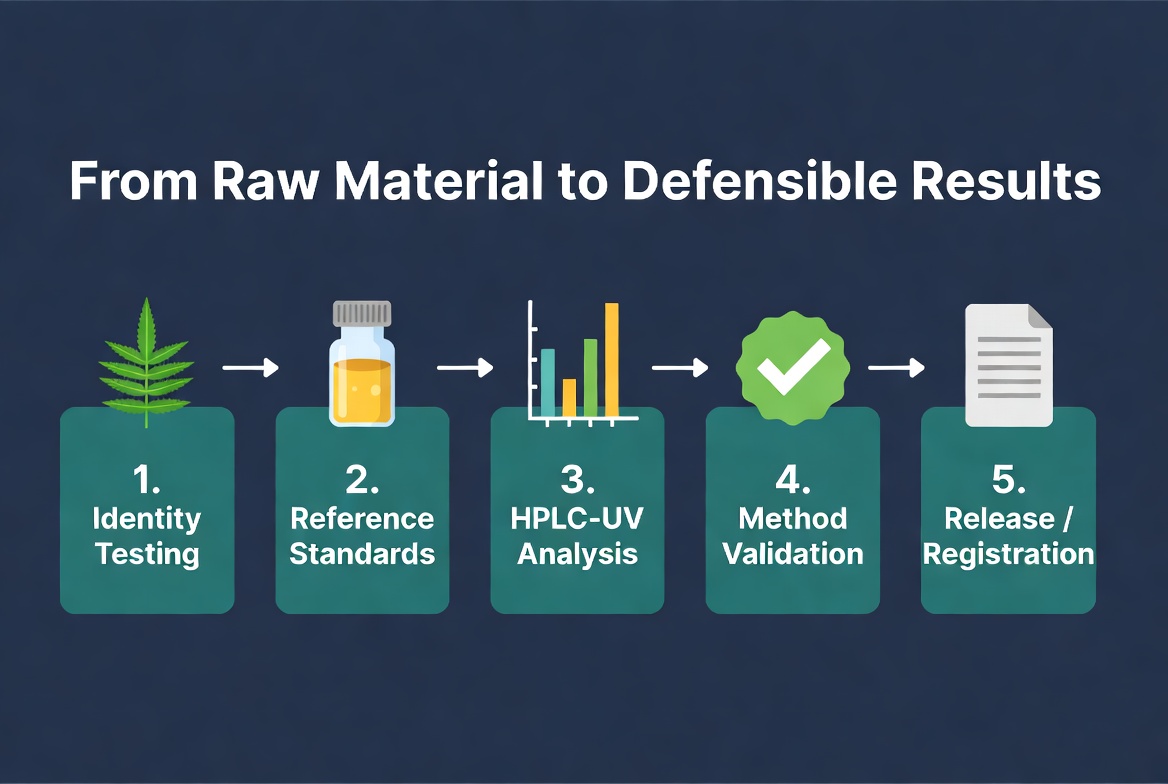
A robust QC program for botanicals integrates identity testing, high-purity reference standards, appropriately validated methods, and strategic outsourcing where beneficial. Whether qualifying neem raw material for agrochemical registration or standardizing cinnamon procyanidins in nutraceutical extracts, the combination of authenticated standards and technically sound approaches produces reliable, compliant data.
When existing tools fall short, our custom isolation and full-service analytical capabilities close the gap from rapid QA methods to validated protocols.
Ready to strengthen your quality control program? Browse our reference standards catalog or contact our technical team to discuss identity testing support, method validation, custom isolation, or outsourced QC services tailored to your needs.
Planta Analytica – High-Purity Reference Standards and Analytical Services for Nutraceuticals, Agrochemicals, and Functional Ingredients.